Market Insight

Your customers are already running their businesses through your platform.
They win the work, manage the jobs, move the freight, place the orders, and track the money inside your product.
Then a moment arrives that software alone cannot resolve. A larger order than usual. A supplier that needs to be paid before the customer’s invoice clears. A season that demands inventory now and returns cash later.
At that moment, many platforms lose the thread. The customer scrambles to find a lender that has little context about how the business actually operates, or delays the purchase, reduces the order, or passes on the opportunity entirely.
The platform has already done the hard part: acquiring the customer, earning trust, becoming part of the workflow, and accumulating data about how the business operates. Yet when capital becomes the constraint, that relationship often moves somewhere else.
Embedded working capital adds that missing layer. It allows a platform to offer financing to business customers, under its own brand and at the point of need, without becoming a lender itself.
This article covers why it matters, where the platform value comes from, and what to evaluate before choosing an embedded lending partner.
How embedded working capital creates value for B2B platforms.
Traditional software economics are usually bounded by some combination of customers, seats, subscription tiers, modules, or usage.
Embedded working capital introduces another dimension: revenue connected to the economic activity the software already supports.
Consider a deliberately illustrative example. These figures are hypothetical and are not Kanmon approval rates, utilization rates, revenue-share terms, or program economics.
Imagine a vertical SaaS platform with 5,000 business customers paying an average of $500 per month. That produces approximately $30 million in annual software revenue.
Now add embedded working capital.
If a portion of those customers access capital through the platform, financing creates an additional economic layer tied to customer activity. Kanmon’s partner economics provide ongoing revenue share from active financing portfolios without requiring the platform to commit its own capital or absorb borrower credit losses.
The specific economics depend on program design, customer demand, portfolio performance, and contractual terms. The strategic point is broader: platform economics no longer have to be tied only to the number of subscriptions sold.
The value can extend beyond revenue share. Customers that can fund inventory, labor, supplier payments, or other operating needs may be able to act on opportunities that would otherwise be constrained by cash timing.
When that happens the platform becomes relevant at another important moment in the customer’s business.
The bigger opportunity: finance the activity your software already enables.
Every B2B platform sits on top of real economic activity.
- A contractor platform helps a contractor win and manage jobs.
- A logistics platform helps move freight.
- An inventory platform helps merchants decide what to buy.
- A procurement platform helps businesses place orders.
- A practice-management platform helps a professional-services business operate.
In each case, there is a recurring constraint: the customer may be able to do more of that activity but lack the working capital to fund it.
The larger job needs materials and labor before the client pays. The bigger inventory order needs cash before the goods sell. A supplier needs payment before the business collects its own receivables.
When lack of capital limits how much of that activity a customer can complete, financing is no longer a bolt-on financial feature. It becomes directly relevant to the platform’s core value proposition.
That is the reframe. Embedded working capital is an extension of the job the platform already does: helping businesses operate and grow.
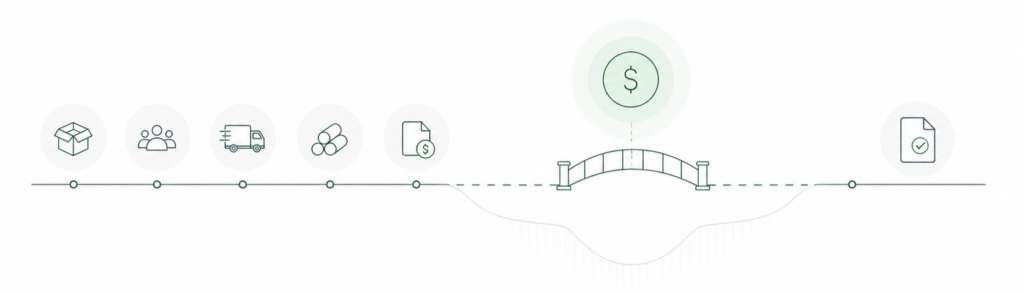
Your customers already have working-capital needs.
The underlying problem is simple: cash often goes out before cash comes back in.
That gap is where working capital matters:
- Inventory must be purchased before it is sold.
- Employees and subcontractors must be paid before customer invoices are collected.
- Freight must move before receivables arrive.
- Materials must be purchased before production begins.
- Suppliers may require payment before the business has converted an order into cash.
A business can win a larger opportunity and still be unable to fund it.
That is a hidden ceiling on customer growth. It may never appear as a support ticket or feature request. The customer simply does less than it otherwise could.
When a platform can help address that constraint inside the workflow, it becomes more useful to the business at a consequential moment.
Why the platform is well positioned to solve it.
For embedded working capital to work, three ingredients matter: distribution, data, and capital.
Many B2B platforms already possess the first two.
Distribution
The business customers already use and trust the platform. The platform is not acquiring an entirely new borrower population from scratch.
Financing can be introduced through an existing customer relationship and an existing workflow rather than through a cold acquisition channel.
Data
The platform can also have operating context that an outside lender would otherwise have to reconstruct.
Depending on the software and integration, that data may include transactions, payments, orders, invoices, job completions, cash-flow patterns, or other operational activity.
That is where an embedded model becomes structurally different from simply sending a customer to a lender. Kanmon’s integration can use transactional and operational data already captured by partner software to inform underwriting and surface financing offers.
The relevant data varies by platform and use case. The important question is whether the provider can use the context your product already has.
Capital
Capital is the piece the platform usually does not have and should not need to build itself.
The role of an embedded lending partner is to provide the lending infrastructure beneath the platform experience. With Kanmon, that includes underwriting, compliance, capital deployment, servicing, and collections.
The platform can own the customer-facing experience without taking on the operational and balance-sheet requirements of becoming a lender.
Should a B2B platform become a lender?
Usually, no.
The important distinction is between owning the customer experience and owning the lending operation underneath it.
A platform may reasonably want to control:
- Brand
- Product placement
- Customer experience
- Product strategy
- Data integration
- Marketing
- Program economics
Those are strategic assets.
It generally does not need to independently build:
- Lending infrastructure
- Compliance operations
- Credit policy and underwriting
- Loan servicing
- Collections
- Capital infrastructure
- Credit-loss management
Those capabilities constitute a lending business of their own.
That division of labor is central to Kanmon’s partnership model: the partner owns the channel, customer relationship, and product experience. Kanmon provides the lending infrastructure underneath it.
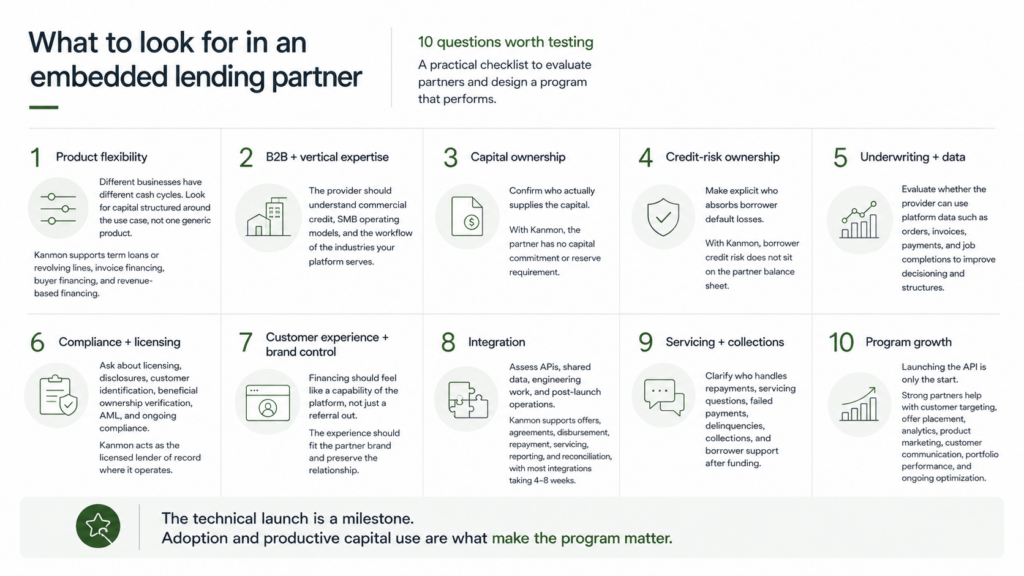
What to look for in an embedded lending partner.
If you are evaluating providers, these are the questions worth testing.
1. Product flexibility
Can the partner support different working-capital needs, or does every business receive essentially the same product?
A contractor funding materials for a project has a different cash cycle from a wholesaler carrying a 60-day receivable or a buyer that needs to pay a supplier before inventory arrives.
Look for a provider that can structure capital around the underlying use case rather than forcing every customer into one generic financing product.
Kanmon supports multiple capital structures, including working capital structured as term loans or revolving lines, invoice financing, buyer financing, and revenue-based financing.
2. B2B and vertical expertise
Does the provider understand commercial credit, SMB operating models, and the industries your customers work in?
Business financing is not consumer lending with a company name added to the application. Cash cycles, receivables, seasonality, inventory, operating history, and business-level risk all matter.
The provider should understand both the borrower and the workflow your platform supports.
This matters particularly across vertical software and business networks where the underlying activity may look very different from one market to the next. Kanmon works with platforms and networks across operations, commerce, financial operations, distribution, supply chain, workforce, and other B2B categories.
3. Capital ownership
Who actually supplies the capital?
Confirm whether your platform must fund loans, maintain a reserve, or make another balance-sheet commitment.
With Kanmon, the partner has no capital commitment or reserve requirement. Kanmon deploys the capital while the partner earns revenue share from the financing portfolio.
4. Credit-risk ownership
Who absorbs losses when a borrower defaults?
Do not leave this implicit.
Kanmon bears the borrower credit risk on financing it originates, so default losses do not sit on the partner’s balance sheet.
5. Underwriting and data
What information can the provider use to evaluate the business?
Can data from your platform improve decision making? How much additional information must a customer supply manually? Can offers be generated before a customer begins a traditional loan application?
Kanmon’s integration can ingest transactional and operational information captured by partner platforms, including data such as orders, invoices, payments, and job completions.
That data can help inform underwriting and the financing structures available to a business.
The relevant inputs will vary by platform and use case. The important question is whether the provider can use the context your product already has.
6. Compliance and licensing
Who is responsible for regulated lending activity?
Ask specifically about licensing, disclosures, customer identification, beneficial ownership verification, AML requirements, and ongoing compliance.
Kanmon acts as the licensed lender of record in the states where it operates and handles regulated lending activity. Its compliance infrastructure includes customer identification, beneficial ownership verification, and BSA/AML requirements.
The platform should understand exactly which responsibilities remain with it and which sit with the embedded lending provider.
7. Customer experience and brand control
Does financing feel like a capability of your platform, or like a referral link to someone else?
Establish where offers appear, how much of the experience can follow your design system, when the embedded lending provider becomes visible, and who owns the relationship.
Kanmon’s model is designed so financing can surface inside the partner’s product and under its brand. The platform retains the customer relationship while Kanmon operates the lending infrastructure underneath it.
8. Integration
What APIs and components are available? What data must be shared? What engineering work is required? What happens after launch?
Kanmon’s integration covers offer generation and delivery, digital agreements, disbursement, repayment and servicing, reporting, and reconciliation.
Most Kanmon integrations complete in four to eight weeks. Actual timing depends on the partner’s technical environment, data readiness, product scope, and implementation requirements.
9. Servicing and collections
Who handles the relationship after capital is deployed?
Ask who manages repayments, servicing questions, failed payments, delinquencies, collections, and borrower support.
Your customer-success organization should understand exactly what will and will not land on its team.
With Kanmon, servicing and collections remain part of the lending infrastructure Kanmon operates after funding.
10. Program growth
Launching an API is not the same as building a financing program customers use.
Ask how the provider supports:
- Customer targeting
- Offer placement
- Program analytics
- Product marketing
- Customer communication
- Portfolio performance
- Ongoing optimization
The technical launch is a milestone. Customer adoption and productive capital use are what make the program matter.
The best embedded lending experience is contextual.
There is a meaningful difference between putting a financing tab in a navigation menu and surfacing capital where the need actually appears.
Useful moments tend to be specific.
- An inventory purchase is larger than usual.
- An approved invoice creates a receivable gap.
- A business wins a large project.
- Seasonal demand is approaching.
- A supplier payment is due before the customer expects to collect cash.
The objective is not to push credit. It is to make financing available when the business already understands why it might be useful.
That is one of the advantages of bringing working capital into the operating platform itself. The software has context about what the customer is trying to accomplish.
How Kanmon approaches embedded working capital.
Kanmon provides the lending infrastructure that allows B2B platforms to offer working capital without becoming lenders themselves.
The platform owns the customer relationship, brand, product experience, distribution, and the operating data generated through its software.
Kanmon handles underwriting, compliance, capital deployment, servicing, and collections. Kanmon also bears the credit risk on financing it originates, while partners can earn ongoing revenue share from active portfolios.
The financing itself can be structured around different operating needs. Kanmon supports working capital through term loans and revolving lines, invoice financing, buyer financing, and revenue-based financing.
Kanmon’s integration connects to transactional and operational data the platform already captures, with infrastructure covering offer generation, acceptance, agreements, disbursement, repayment, servicing, and reporting.
And one distinction is worth stating plainly:
Embedded payments are not a prerequisite.
A platform does not need its own payments product before adding working capital. Payments and transaction data can be useful when available, but Kanmon does not require a payments product before a platform can offer embedded working capital.
The market context.
The financing need is not theoretical.
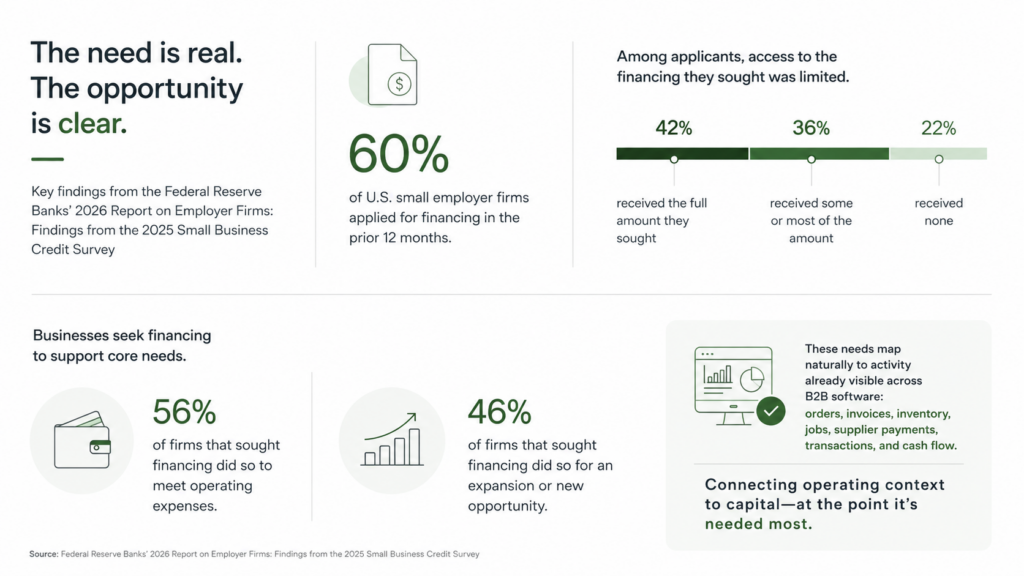
According to the Federal Reserve Banks’ 2026 Report on Employer Firms: Findings from the 2025 Small Business Credit Survey, 60% of U.S. small employer firms applied for financing in the prior 12 months.
Getting all of the capital they sought was far from guaranteed. Among applicants, 42% received the full amount of financing they sought, 36% received some or most, and 22% received none.
The reasons businesses seek financing also connect directly to the workflows B2B platforms support. In the same Federal Reserve survey, 56% of firms that sought financing did so to meet operating expenses, while 46% were pursuing an expansion or new opportunity.
Those needs map naturally to activity already visible across B2B software: orders, invoices, inventory, jobs, supplier payments, transactions, and cash flow.
The opportunity for a platform is to connect that operating context with capital at the point where it becomes useful.
Frequently asked questions.
01
What is embedded working capital?
Embedded working capital is business financing delivered through the software or platform a business already uses to operate.
Rather than sending the customer elsewhere to find a lender, the financing experience can be integrated into the platform workflow and presented under the platform’s brand, while the embedded lending provider handles the lending infrastructure underneath it.
02
How is embedded lending different from a business loan referral program?
A referral typically sends the customer to a separate lender experience.
Embedded lending integrates financing into the platform itself. The platform can control where financing appears and how it fits into the customer experience rather than treating capital as an external handoff.
03
Does my platform need embedded payments before it can offer embedded lending?
No.
Payments and transaction data can be useful inputs, but Kanmon does not require a platform to own or embed payments before offering working capital.
04
Does my platform have to fund the financing?
No.
Kanmon deploys the capital. Partners do not need to maintain a reserve or put their own balance sheet behind borrower financing.
05
Who assumes the credit risk?
Kanmon bears the borrower credit risk for financing it originates and handles collections.
06
What financing products can be embedded?
Kanmon supports working capital through term loans and revolving lines, invoice financing, buyer financing, and revenue-based financing. The appropriate structure depends on the business and use case.
The need for capital already exists.
The strategic question is whether that need sends them somewhere else or whether your platform can help solve it at the point where the need occurs.
See how Kanmon can make working capital a native part of your platform.
If your customers run their businesses through your product, let’s talk about where capital fits.
Source
Federal Reserve Banks. 2026 Report on Employer Firms: Findings from the 2025 Small Business Credit Survey. Published March 3, 2026. DOI 10.55350/sbcs-20260303.