Market Insight

For most businesses, the need for working capital is not unusual. It is part of operating.
Inventory has to be purchased before it is sold. Suppliers may need to be paid before customers pay their invoices. Labor and materials can be required weeks before a project generates cash. A growing business may win an opportunity that it cannot fully pursue without additional capital.
That creates an important question for the software platforms, marketplaces, and business networks these companies already rely on:
If the need for capital is created inside the workflow, why should the business have to leave that workflow to solve it?
That is the basic premise behind embedded lending.
What is embedded lending?
Embedded lending is the integration of financing directly into a non-financial platform, marketplace, or software experience. Instead of requiring a business to separately find a lender and begin a disconnected application process, financing can be made available through the technology the business already uses to operate.
For business platforms, embedded lending can extend an existing product from helping customers manage their work to helping them finance it.
For merchants and other small businesses, the benefit is just as straightforward: access to capital can appear closer to the moment and context in which the need actually occurs.
That matters because the need for financing remains significant.
Small businesses continue to need capital.
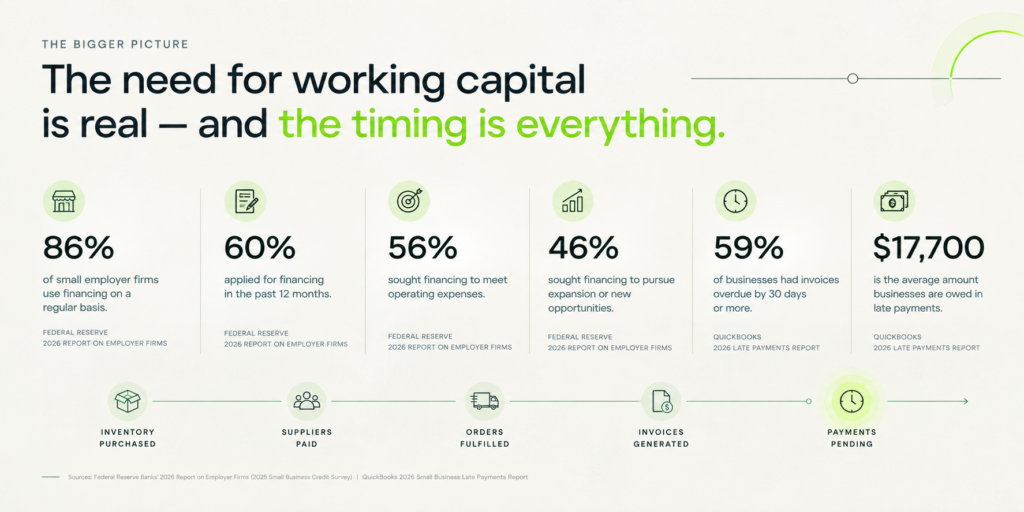
The Federal Reserve Banks’ 2026 Report on Employer Firms, based on the 2025 Small Business Credit Survey, found that 86% of small employer firms use financing on a regular basis. Sixty percent applied for financing during the preceding 12 months.
The reasons were not limited to businesses in distress. Among firms seeking financing, 56% wanted it to meet operating expenses, while 46% sought capital to pursue an expansion or new business opportunity.
That distinction is important.
Working capital is sometimes discussed only as a solution to a problem. But businesses also need capital because something is going right: a larger order arrives, demand increases, a new location becomes possible, inventory needs to be purchased, or a company has an opportunity to grow faster than its cash conversion cycle allows.
At the same time, obtaining all of the capital a business wants is far from guaranteed. The same Federal Reserve survey found that only 42% of financing applicants received the full amount they sought. Another 36% received some or most of it, while 22% received none.
That gap between capital needed and capital available is one reason alternative models for delivering business financing continue to develop.ension of the job the platform already does: helping businesses operate and grow.
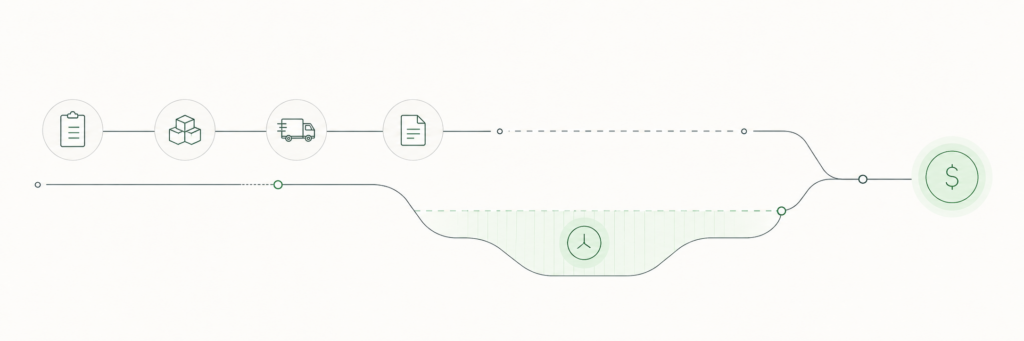
The underlying problem is often timing.
A profitable business can still have a working-capital problem.
Revenue and cash are not the same thing, and they rarely arrive at exactly the same time expenses do.
Consider a wholesaler that needs to purchase inventory today but will not collect from its customers for 30 or 60 days. Or a contractor that needs to buy materials and pay employees before completing a project. Or a supplier that has delivered an order but is still waiting for an invoice to be paid.
Recent research illustrates how common that timing problem remains.
The 2026 QuickBooks Small Business Late Payments Report found that 59% of surveyed businesses had invoices overdue by 30 days or more, up from 47% the prior year. Businesses waiting on unpaid invoices were owed $17,700 on average.
The cash-flow consequences can extend beyond late invoices themselves. Nearly half of owners surveyed, 49%, said standard payment-processing times created critical or moderate cash-flow gaps even after their customers had paid.
In other words, the financing need is frequently connected to a workflow that another business system can already see.
- An order was placed.
- An invoice was generated.
- Inventory moved.
- A payment is pending.
Revenue is occurring, but the timing of cash does not line up with the timing of the business’s obligations.
That is where embedded lending becomes particularly interesting.
Why offer financing through the platform a business already uses?
Businesses increasingly operate through specialized software.
Accounting systems, ecommerce platforms, logistics networks, field-service applications, vertical SaaS products, marketplaces, and other systems are no longer just administrative tools. They often sit directly in the flow of transactions and day-to-day operations.
Boston Consulting Group reported in 2025 that adoption of vertical software among U.S. small and midsize businesses reached 59% in 2024, up from 50% just two years earlier. BCG describes vertical SaaS platforms as becoming the de facto operating systems for many SMEs. Read the BCG research.
That creates several natural advantages for embedded lending.
1. The business is already there
A merchant does not need another destination.
It is already logging into the platform to manage orders, invoices, payments, inventory, customers, jobs, shipments, or other important parts of the business.
BCG notes that existing software relationships can give SaaS companies an efficient distribution channel for financial products and an opportunity to deliver relevant services to customers in context.
That does not mean every business wants financing from its software provider. Traditional banking relationships remain important, and embedded finance has to earn its place by creating a useful experience.
But a platform has something an outside lender may not have: context and timing.
2. The platform may understand why the capital is needed
Traditional financing applications often begin by asking a business to explain itself.
A platform may already understand a meaningful part of the story.
Depending on the product, it may see sales, receivables, invoices, transaction volumes, purchase orders, inventory movements, project activity, or other signals generated through normal business operations.
BCG identifies access to underwriting data and deep customer connectivity as potential advantages software providers can bring to embedded financial products.
That data does not replace responsible underwriting. But when combined with financial and credit information, it can provide additional context for understanding the business and the use case behind a request for capital.
This is also central to how Kanmon’s embedded lending model works: partner software can connect the operational data it already captures with lending infrastructure designed to evaluate and deliver working capital.
3. Financing can appear closer to the point of need
Capital is more useful when a business can access it at the right time.
A generic financing advertisement delivered months before or after a need develops has limited relevance.
Embedded lending creates the possibility of a more contextual experience.
A platform may know that a seller is growing, that invoices are outstanding, that transaction volume has increased, or that another working-capital need has emerged within the workflow.
The experience can therefore move from:
Do you ever need financing?
to something closer to:
You have a business need now. Here is an option available to help finance it.
That is a meaningful difference.
Why embedded lending makes sense for the platform, too.
The merchant benefit is only half of the equation.
For B2B platforms, embedded lending can add value to the core product without requiring financing to become the core product.
Extend the value of the existing workflow
A strong platform already helps its customers accomplish something important.
It might help them sell products, manage inventory, move freight, complete jobs, invoice customers, procure goods, or run another critical business process.
But nearly every one of those activities eventually intersects with cash flow.
Embedded lending allows the platform to address that adjacent need without forcing the customer to leave the ecosystem to find a solution.
The goal is not to turn a software product into a bank.
It is to make the software more useful at a moment that matters to the customer.
For platforms trying to determine whether their own customer and data model fits this opportunity, Kanmon outlines the types of B2B platforms that can be well suited to embedded working capital.
Create another reason for customers to engage
The more meaningful problems a product helps customers solve, the more central that product can become to running the business.
Embedded payments have already demonstrated part of this progression. BCG reported that more than half of relevant independent software vendors in North America offered embedded payments in 2025, with integrated payments becoming both a monetization lever and a way to deepen relationships with SMEs.
- Lending represents a logical next layer where the use case fits.
- The platform helps the business manage the activity.
- Payments can help facilitate the transaction.
Capital can help the business fund the activity that produces the transaction in the first place.
Add a new economic layer without changing the primary business model
Platforms do not need to build lending infrastructure themselves to participate in embedded lending.
With the right lending partner, functions such as capital, underwriting, compliance, servicing, and credit risk can sit behind the platform experience while the platform continues to own its primary customer relationship.
That is how Kanmon approaches embedded working capital. The platform connects its software and owns the customer-facing experience, while Kanmon handles underwriting, compliance, capital deployment, servicing, and collections.
There can also be a direct economic benefit to the platform. Through Kanmon’s partner economics, partners can earn ongoing revenue share when their customers use capital, without putting their own capital behind the financing.
The result is an additional value-added service built around an audience and workflow that already exist.
Embedded lending works best when it feels embedded
Simply placing a financing link inside a software product does not necessarily create a meaningful embedded-lending experience.
The opportunity is strongest when financing reflects the platform itself:
- the types of businesses using it
- the workflows those businesses manage
- the timing of their working-capital needs
- the data available to help understand those businesses
- and the broader customer experience of the platform
BCG makes a similar distinction in its embedded-finance research, emphasizing the importance of targeted outreach, the right product-market fit, and financial products that address actual SME needs.
That is an important point for any platform evaluating embedded lending.
Access alone is not the product. Relevance is.
The best experience is not necessarily one in which a business is constantly being offered credit. It is one in which financing is available when the operating context makes its usefulness clear.
Working capital is becoming part of the software value proposition
What information can the provider use to evaluate the business?
The case for embedded lending starts with a simple observation.
Businesses already need capital.
They already run important parts of their operations through software platforms.
And those platforms can have a closer view of the activities creating the financing need than a lender encountering the business for the first time.
Putting those pieces together can create a better model for both sides.
For merchants, embedded lending can make financing more contextual to the way they actually operate. Businesses can potentially address an inventory purchase, receivables gap, supplier payment, payroll requirement, or growth opportunity through a platform they already use. See examples of the business needs working capital can address.
For platforms, embedded lending can extend the value of an existing product, deepen the customer relationship, and introduce an additional financial service without requiring the company itself to become a lender.
The opportunity is not to add finance for finance’s sake.
It is to recognize that when a platform helps a business operate, access to capital can become a natural extension of the work the platform already enables.
For a deeper look at program structure, integration, credit risk, product flexibility, and the questions platforms should ask prospective providers, read our buyer’s guide to embedded working capital for B2B platforms.
Frequently asked questions about embedded lending.
01
What is embedded lending?
Embedded lending is business financing integrated directly into a non-financial software platform, marketplace, or other digital product. It allows eligible businesses to access financing within an experience they already use rather than beginning with a separate lender.
02
Why do small businesses need working capital?
Businesses use working capital to address differences between when expenses have to be paid and when cash comes into the business. Common needs include inventory purchases, payroll, materials, supplier payments, receivables gaps, and financing new growth opportunities.
The Federal Reserve’s 2026 Small Business Credit Survey found that operating expenses and expansion or new opportunities were the two most common reasons small employer firms sought financing.
03
Why are software platforms well positioned to offer embedded lending?
Platforms can combine existing customer relationships, frequent product engagement, and operational data with lending infrastructure supplied by a financial partner.
Depending on the platform, information such as payments, invoices, orders, transactions, job completions, or cash-flow patterns may provide useful context about how a business operates. This can make financing more closely connected to the workflow creating the need.
04
Does a platform have to become a lender to offer financing?
Not necessarily. An embedded lending provider can manage lending functions such as underwriting, compliance, funding, servicing, and collections while allowing financing to be delivered through the platform experience.
In Kanmon’s model, Kanmon provides that infrastructure while the partner retains its core software product and customer relationship.
05
What types of platforms can offer embedded lending?
Embedded lending can be relevant for many B2B platforms that have an established business-customer relationship and visibility into how those customers operate.
Examples include operations and management software, commerce and ordering platforms, financial operations tools, payments and transaction platforms, distribution and supply-chain networks, and workforce-management platforms. Learn more about where Kanmon fits.
06
How is embedded lending different from referring customers to a lender?
A referral typically sends the customer to a separate lender and a separate experience.
Embedded lending brings financing into the platform itself. Depending on the implementation, the platform can control where financing appears, how it is presented, and how it fits into the broader customer experience while a lending provider operates the infrastructure underneath it.
Sources and references
Federal Reserve Banks, 2026 Report on Employer Firms: Findings from the 2025 Small Business Credit Survey, published March 3, 2026. The nationwide survey included 6,525 responses from small employer firms with 1–499 employees.
Intuit QuickBooks, 2026 Small Business Late Payments Report, published July 7, 2026. Findings cited include prevalence of invoices overdue 30+ days, average unpaid invoice balances, and reported cash-flow effects of payment-processing delays.
Boston Consulting Group, Moving Embedded Finance from Promise to Practice, published September 9, 2025. Findings cited include U.S. SME adoption of vertical software, adoption of embedded payments among relevant North American software providers, and the potential distribution and data advantages of vertical SaaS providers.